
I think I have reached the point where I need at least two different AIs to properly work.
That sentence alone would have sounded completely absurd to me maybe two years ago.
And yet here we are.
It’s not the AI’s fault !
The funny thing is: this is not the fault of AI. Not at all. This is entirely my own doing. I voluntarily pushed myself into this dependency because I realized that I can suddenly do things alone which previously required an actual programmer, sometimes an entire development team, or at the very least somebody with far deeper coding experience than me.
And that changes your thinking. Completely.
I can program. I always could. Enough to automate things, build websites, debug systems, structure projects and communicate properly with developers. That last part was always one of my strengths anyway: I understand exactly what developers mean, what they need, where the risks are, where management is talking nonsense again, and where technical debt is silently preparing the next disaster in the basement.
But once software projects went really deep, I usually hit my limits eventually. Not immediately — which honestly is sometimes even worse — but somewhere after the “this actually works” phase, where architecture, maintainability, scaling, security and edge cases slowly enter the room with a baseball bat.
And that was often the point where projects either became expensive, political, dependent on other people, or simply died.
A sad example from the past
About ten years ago, when New Zealand was still basically my home base, I had a project idea connected to TradeMe. For the Europeans reading this: TradeMe is essentially New Zealand’s eBay. Except eBay never really became dominant there because they do not allow trading live animals, while TradeMe does — and in New Zealand that actually matters a lot more than some people might think 😄
But that is another story for another day.
The important part is: the project idea itself was genuinely good. Honestly, I still think it could work today. We even started building it and progress was surprisingly solid for a while.
Until human nature entered the chat.
My project partner eventually decided he wanted a larger piece of the cake than originally agreed upon. I considered that unfair and declined. Long story short: the project died right there. Not because the idea failed. Not because the market disappeared. Not because the technology was impossible. It died because humans are humans and startup romanticism usually survives exactly until somebody starts calculating percentages.
That happens far more often in IT than people realize.
Skipping only 10 years
And now suddenly, ten years later, I sit here working with AI as my coder while another AI reviews results, helps me identify weaknesses, structures my next sprint and effectively acts like a slightly autistic senior consultant living in my browser tabs.
And the really disturbing part?
It works frighteningly well.
I am currently preparing my first real freeware tool release. A proper one. Something people might actually use. Nerds, normal users, data hoarders, maybe a few over-organized archivists with seventeen external hard drives and naming conventions from hell.
And if I am completely honest — which I try to be — then yes, of course I also hope this eventually generates business opportunities. Consulting requests. Custom features. Local setup support. Implementation projects. The usual chain reaction.
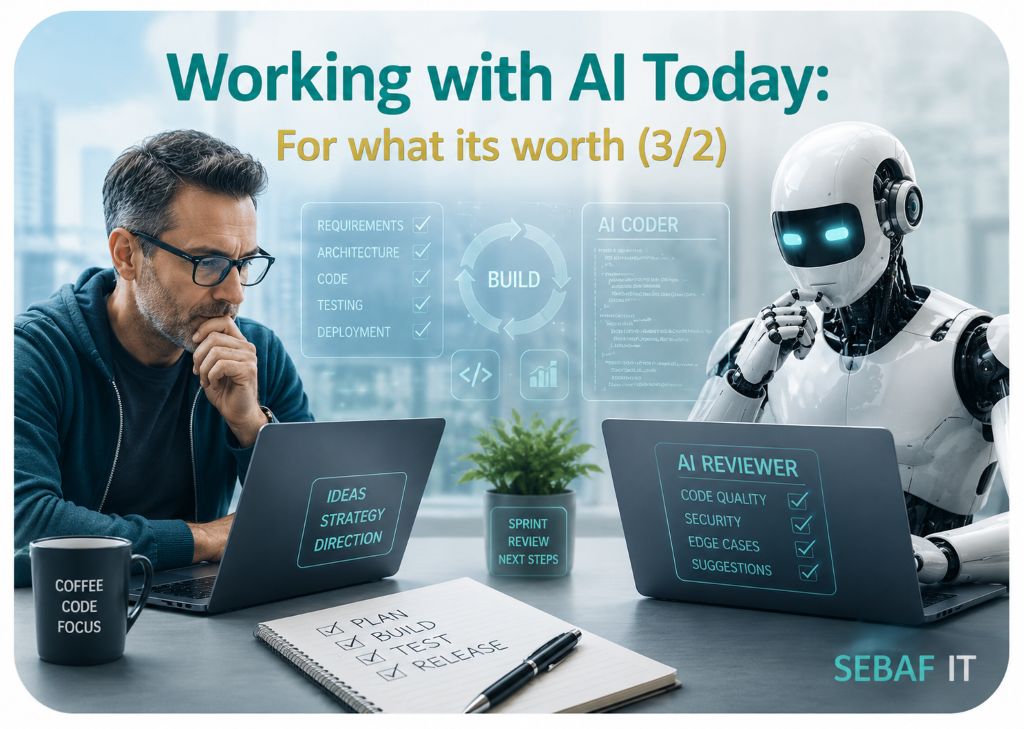
SEBAF IT is still a business after all and not a spiritual retreat somewhere in the mountains 😉
But despite all the excitement, I notice something else happening at the same time.
Something psychologically weird.
My workday currently changes so absurdly fast that I sometimes struggle to mentally keep up with my own workflow evolution. And I don’t think I am alone with that feeling. I think many people in IT currently exist in this strange frozen state somewhere between fascination and low-level fear.
We all keep using these tools because we want to understand them.
At first it feels like curiosity, then productivity, then acceleration. And then suddenly dependency quietly enters the room without asking permission.
That is the spooky part.
You notice it in tiny moments, you stop Googling things first. You stop writing first drafts manually. You stop approaching problems alone. You stop brute-forcing documentation.
You stop thinking “Can AI help me here?” because eventually your brain silently switches to “Why would I NOT use AI for this?”
And once that switch happened, there is no going back to the old workflow without feeling strangely handicapped.
The AI revolution has begun?
That realization honestly makes me uncomfortable sometimes, because now comes the dangerous question: Is this actually good? Or should we focus on something else?
But then immediately the next question appears:
What exactly would “something else” even look like now WITHOUT AI? That is when you realize the actual revolution is already over. People still talk about “the upcoming AI revolution” as if we are waiting for some future event. No.
That ship has sailed already.
The AI takeover did not happen with explosions, killer robots or dramatic press conferences. It happened quietly while millions of people slowly changed how they work, think, organize, communicate and create things.
One workflow at a time. And most people still do not fully notice it.
That honestly scares me more than the technology itself.
Because even I — somebody who has been obsessively watching and using this stuff since the beginning — still feel hilariously far left on the Dunning-Kruger curve. The deeper you go into this topic, the less certain you become. Every few weeks another capability appears that suddenly shifts entire workflows again.
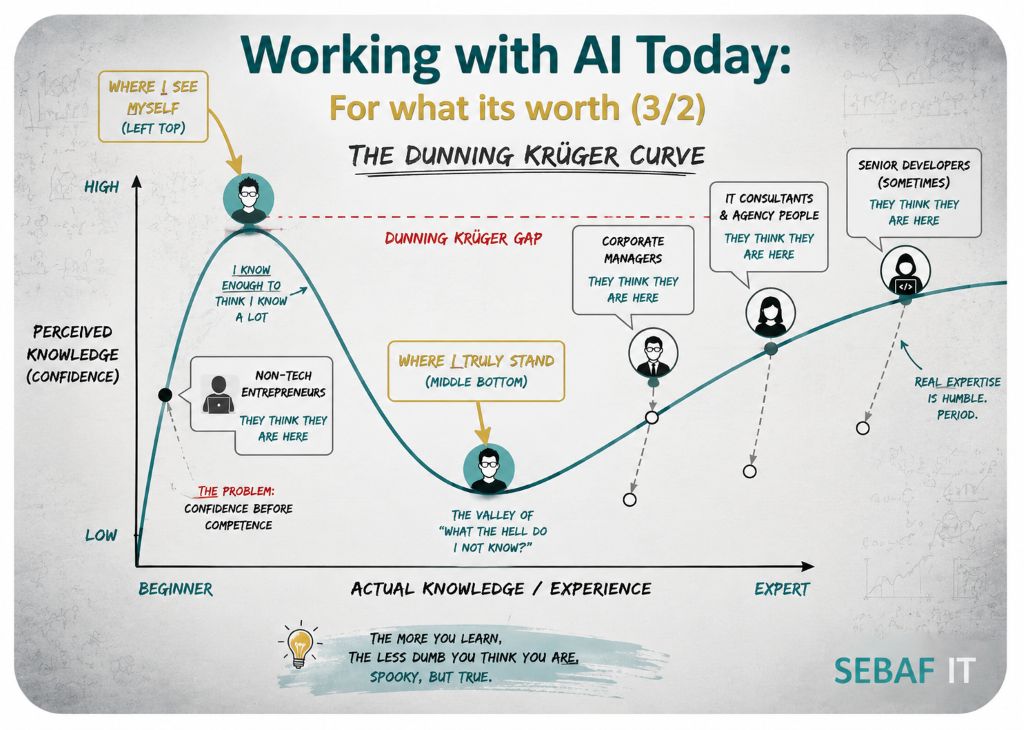
And that feeling is deeply unsettling, especially because many non-technical people still think AI is basically “that chatbot thing.” Meanwhile some of us are already restructuring our entire professional existence around it.
Spooky. Very spooky.
And maybe the weirdest part of all is this: I am not even sure I want to stop.