
Yesterday I started my day at version 0.8.0.1 around 7:22 in the morning. By the evening I had arrived at version 0.8.6 after fourteen consecutive development sprints. Fourteen. In one day. And before somebody from corporate middle management enters the chat with “well technically a sprint should…” — please don’t. Nobody outside SAFe consulting slideshows still believes that nonsense anyway.
I mean actual work. Real iterations. Real scope adjustments. Real debugging. Real releases. Real testing. Real “why does this suddenly explode only on this specific machine at 19:42?” moments.
In old-money software development terms, this amount of progress would realistically have required a small dev team and at least a week of coordination meetings, Jira rituals, architectural discussions, somebody crying and a Product Owner pretending sticky notes are not only romantic, but a leadership methodology.
Today I need two AIs, enough caffeine (to concern my cardiologist) and roughly 200–300 Euro per month.
What an absolutely ridiculous time to live in
And no, before the internet once again reduces everything into primitive “AI replaces developers” bait:
That is not what I am saying. In fact, the exact opposite is true. The reason this works for me is because I actually can program. Not perfectly. Not “Silicon Valley TED Talk founder in black turtleneck” level. But enough to understand what is happening under the hood. Enough to understand architecture, dependencies, workflows, debugging, edge cases and technical consequences. Enough to notice when the AI starts hallucinating absolute nonsense with horrifying confidence.
Because THAT is currently the funniest and simultaneously most dangerous aspect of modern AI-assisted development: if you do not know your technical vocabulary, the AI will absolutely destroy you.
Politely.
Professionally.
With perfect grammar.
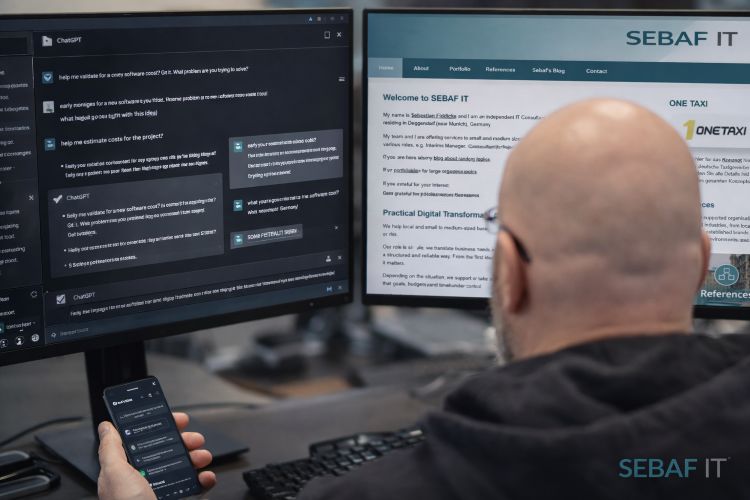
The current generation of AI is basically the fastest developer you have ever worked with, combined with the most overconfident intern in human history. It can produce 500 lines of elegant-looking code in seconds while quietly introducing a logic flaw so catastrophic that your next release candidate becomes a controlled explosion, after, of course, looking great at a glance!
And if you lack the experience to notice this, you are finished. Done. Shouldn’t have started it.
This is why I increasingly laugh when people say things like:
“I don’t need to learn programming anymore because AI does everything now.”
No. Quite the opposite. AI massively rewards competence. The more you already understand, the more absurdly powerful these systems become. The less you understand, the more dangerous they become. The AI does not magically replace understanding. It amplifies it. Or amplifies the lack thereof. Which explains quite a lot about LinkedIn these days, actually.
At university, I really wonder what young peoples‘ curriculum must be looking like when needing to learn real programming these days? I feel kind of sorry for those young folks just starting out their carreers today.
Welcome to AI Orchestration Hell™
The really bizarre part is that troubleshooting has become one of my favorite parts of the workflow now. Which sounds deeply unhealthy when written down like this. But troubleshooting always was one of my strongest skills anyway. I genuinely enjoy identifying where systems drift apart from reality.
The difference is that today I literally use one AI to debug another AI.
Read that sentence again slowly. And another time.
One AI reviews the code another AI generated, while I sit in the middle acting as some caffeinated diplomatic translator trying to prevent both of them from accidentally setting parts of the project on fire.
And the horrifying thing? It’s that this works astonishingly well.
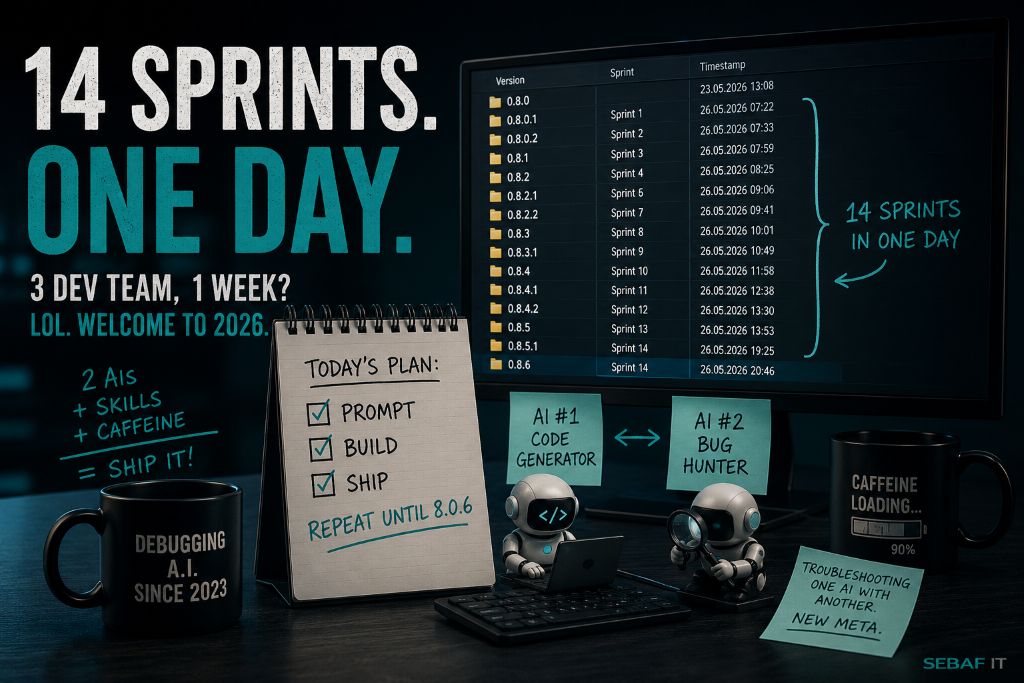
Five years ago I would have needed:
- frontend developer
- backend developer
- project manager
- tester
- architecture discussions
- deployment coordination
- release planning
Today I basically conduct a strange orchestra of semi-autistic machine intelligences inside browser tabs while occasionally muttering “why would you even DO it like this?” at 2 AM.
Cyberpunk arrived. It just arrived looking like browser windows and monthly subscriptions instead of neon implants and flying cars.
The Part That Actually Worries Me
All the sarcasm and fascination aside, there is also something deeply unsettling about this acceleration. My workflow changes so absurdly fast now that I no longer trust my own ability to predict what my professional reality will look like even six months from now.
Six months used to mean something in IT.
Today six months feels like trying to forecast the climate of Jupiter using an Excel sheet and emotional support.
And yes, if I am completely honest, I am absolutely convinced AI will eventually be able to replace large parts of what I currently do as well. Probably even me entirely at some point.
Sigh.
But until then, I will continue riding this completely absurd wave because — and this is the really dangerous part — I genuinely enjoy it.
Which probably means we are already too far gone anyway.