
There’s a lot of noise around AI right now. Revolution. Disruption. End of work. Start of everything.
Maybe.
But that’s not what changed my day-to-day. What changed is much simpler:
I finally have somewhere to take my ideas immediately.
And that matters more than people think.
My head has always been busy. Ideas show up constantly — business, software, random projects, sometimes brilliant, often questionable, occasionally both at once. The real problem was never having ideas.
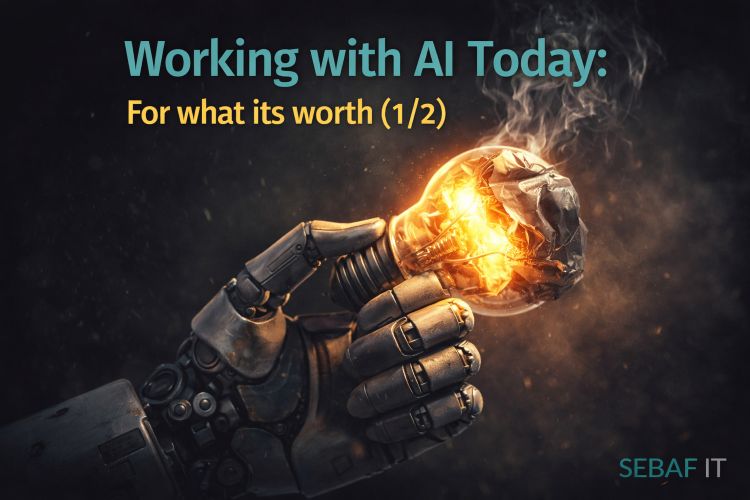
The problem was what to do with them fast enough before they either disappeared or turned into unchallenged fantasies. Before AI, every idea was – naturally – very shortlived, because you had to capture the idea first, structure it somehow, and then — most annoying part — translate it into something another human expert could react to. That meant time, context, availability, and usually a bit of social negotiation. By the time you got useful feedback, the idea was either cold or already emotionally overvalued.
AI removes that gap. Now the idea shows up — and I can work on it instantly.
Raw, unfinished, slightly chaotic — doesn’t matter. I throw it into ChatGPT and start pushing it. Does it make sense? Where does it break? What would it cost? What am I underestimating? What would a structured version of this look like?
The key is not that the answers are perfect. The key is that they are immediate and usable. That gives you momentum, and momentum is everything at that stage.
What used to take days of scattered thinking and delayed conversations now happens in one focused session. You go from a vague thought to something that at least resembles a plan — rough structure, first numbers, risks, trade-offs. Not final, but solid enough to move forward intelligently.
That alone upgrades every real-world conversation that follows.
Because you’re no longer saying:
“I have an idea…”
You’re saying:
“I’ve thought this through — here’s where I need your input.”
That’s a different level, because one of the most valuable „side“ effects: bad ideas die faster. And that’s a feature.

Most ideas are not worth pursuing. They just used to live longer because killing them required effort. Now they get pressure-tested early. Weak assumptions show up quickly. Gaps become obvious. Numbers don’t work. Fine. Move on. No sunk cost, no emotional attachment, no weekend wasted.
At the same time, the few ideas that survive that first round? They come out sharper. More realistic. Closer to execution. AI doesn’t just help you generate ideas, it helps you filter and shape them at speed.
And no — it’s not always right. If you treat it like an oracle, you’ll get nonsense with confidence. But if you understand its limitations, it becomes extremely effective. You’re not using it for truth. You’re using it for structured thinking, fast iteration, and early-stage due diligence.
That’s the real leverage. For me, the biggest shift is this: I no longer get stuck at the idea stage.
And that’s probably the most underrated benefit of AI right now. Not that it replaces thinking, but that it forces you to do it properly — and immediately.
Part 2 is zooming out a bit and looks at what this means for businesses, teams, and why most SMEs are massively underestimating what’s sitting right in front of them.